

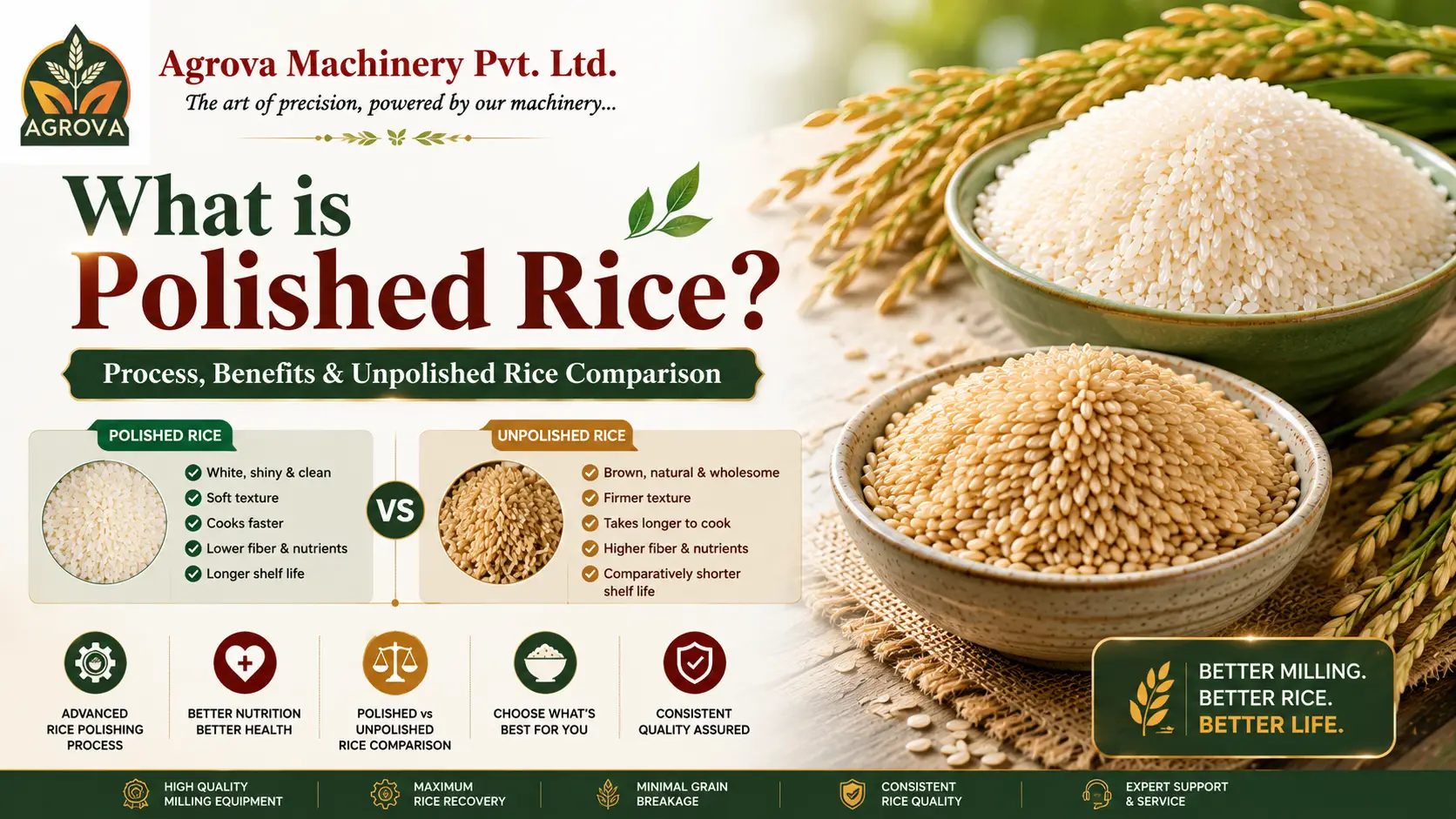
Rice is one of the most widely consumed staple foods across the world, especially in Asian countries. During rice processing, paddy undergoes several stages before reaching consumers in its final form. One of the most common forms available in the market is polished rice, known for its bright white appearance, smooth texture, and longer shelf life.
Understanding the polishing process and the differences between polished and unpolished rice can help consumers and rice mill operators make informed decisions. With advanced rice processing solutions from Agrova Machinery, rice mills can achieve efficient polishing, improved rice quality, and higher production output.
What is Polished Rice?
Polished rice is rice that has undergone a milling and polishing process to remove the outer bran layer and germ from the grain. After the husk is removed, the rice is further processed using polishing machines to produce a smooth, shiny, and white grain.
The polishing process improves the appearance of rice and enhances its market value by giving it a clean and attractive finish.
Polished Rice Meaning
Polished rice refers to rice grains from which the husk, bran layers, and germ have been removed through milling and polishing, resulting in a smooth white appearance.
Polished Rice Manufacturing Process
1. Rice Polisher Machine
A rice polisher machine removes the remaining bran layer from brown rice and gives the grains a smooth, white, and attractive finish. Modern machines ensure uniform polishing with minimal grain breakage.
Uniform grain appearance
Improved rice whiteness and shine
Reduced grain breakage
Higher market value
2. Friction and Buffing
During polishing, rice grains rub against each other and polishing surfaces. This friction removes fine bran particles and improves the whiteness, smoothness, and shine of the rice.
3. Cooling and Dust Removal
Polishing generates heat and bran dust. Cooling systems and dust aspirators help maintain grain quality, prevent cracking, and remove loose bran particles from the rice.
4. Desired Polish Level
The polishing intensity can be adjusted according to market requirements. Rice mills can produce lightly polished or highly polished rice while maintaining grain quality and reducing wastage.
Benefits:
- Customized rice finish
- Better product quality control
- Reduced grain wastage
- Higher commercial value
What is Unpolished Rice?
Unpolished rice is rice that retains its natural bran layer and germ after the outer husk is removed. Unlike polished rice, it does not undergo extensive polishing, allowing it to preserve more of its natural nutrients, fiber, vitamins, and minerals. Due to the presence of the bran layer, unpolished rice has a slightly brown appearance, a nuttier flavor, and a firmer texture.
Difference Between Polished and Unpolished Rice
Processing: Polished rice undergoes polishing to remove the bran layer and germ, while unpolished rice retains these natural layers.
Appearance: Polished rice is white and shiny, whereas unpolished rice has a brownish and natural appearance.
Nutrition: Unpolished rice contains more fiber, vitamins, and minerals compared to polished rice.
Texture: Polished rice is softer after cooking, while unpolished rice has a firmer and slightly chewy texture.
Cooking Time: Polished rice cooks faster, whereas unpolished rice requires more cooking time.
Shelf Life: Polished rice generally has a longer shelf life due to the removal of bran and germ.
Consumer Preference: Polished rice is popular for its appearance and texture, while unpolished rice is preferred by health-conscious consumers.
Polished VS Unpolished Rice
| Feature | Polished Rice | Unpolished Rice |
|---|---|---|
| Processing | Undergoes milling and polishing to remove bran and germ | Only the outer husk is removed |
| Appearance | White, smooth, and shiny | Brownish and natural-looking |
| Bran Layer | Removed during polishing | Retained |
| Fiber Content | Lower fiber content | Higher fiber content |
| Nutritional Value | Contains fewer natural nutrients | Rich in vitamins, minerals, and fiber |
| Texture | Soft and smooth after cooking | Firmer and slightly chewy |
| Cooking Time | Cooks faster | Takes longer to cook |
| Shelf Life | Longer shelf life | Comparatively shorter shelf life |
| Consumer Preference | Popular for its appearance and texture | Preferred by health-conscious consumers |
| Market Demand | Widely consumed worldwide | Growing demand in health food markets |
Polished vs Unpolished Rice: Which One Should You Choose?
- Choose Polished Rice if you prefer a soft texture and white appearance.
- Choose Polished Rice if you want faster cooking and easier preparation.
- Choose Polished Rice if longer shelf life is important.
- Choose Unpolished Rice if you want higher fiber content.
- Choose Unpolished Rice if you prefer more natural vitamins and minerals.
- Choose Unpolished Rice if you are looking for a less processed rice option.
- Choose Unpolished Rice if you prefer a firmer texture and nutty flavor.
Final Choice
- For appearance, texture, and convenience: Polished Rice.
- For nutrition and fiber content: Unpolished Rice.
- For daily consumption: Both can be included in a balanced diet depending on personal preference and dietary requirements.
FAQs About Polished Rice and Unpolished Rice
1. What is polished rice?
Polished rice is rice that has undergone milling and polishing to remove the bran layer and germ, giving it a white, smooth, and shiny appearance.
2. What is unpolished rice?
Unpolished rice is rice that retains its bran layer and germ after the outer husk is removed. It is commonly known as brown rice.
3. What is the main difference between polished and unpolished rice?
The main difference is that polished rice has its bran layer removed, while unpolished rice retains it, resulting in higher fiber and nutrient content.
4. Which rice has more nutritional value?
Unpolished rice generally contains more fiber, vitamins, and minerals because it retains the bran layer and germ.
5. Why is polished rice white in color?
Polished rice becomes white because the outer bran layer is removed during the polishing process.
6. Which rice cooks faster?
Polished rice cooks faster than unpolished rice because the outer bran layer has been removed.
7. Which rice has a longer shelf life?
Polished rice typically has a longer shelf life due to the removal of the oil-rich bran and germ.
8. Is unpolished rice the same as brown rice?
Yes, unpolished rice is commonly referred to as brown rice because it retains its natural bran layer.
9. Why is rice polishing important?
Rice polishing improves the appearance, texture, and market value of rice, making it more appealing to consumers.
10. Which rice is preferred by consumers?
Both types are popular. Polished rice is preferred for its appearance and soft texture, while unpolished rice is chosen for its nutritional benefits.
Conclusion
Polished rice is a widely preferred rice variety known for its smooth texture, bright appearance, and longer shelf life. The polishing process removes the bran layer and germ, resulting in a refined grain that is popular in domestic and commercial markets. On the other hand, unpolished rice retains more natural nutrients and fiber, making it a preferred choice for health-conscious consumers.
For rice mill owners seeking efficient and reliable rice processing solutions, Agrova Machinery offers advanced rice polishing machines and complete rice milling systems designed to improve productivity, rice quality, and operational efficiency.